
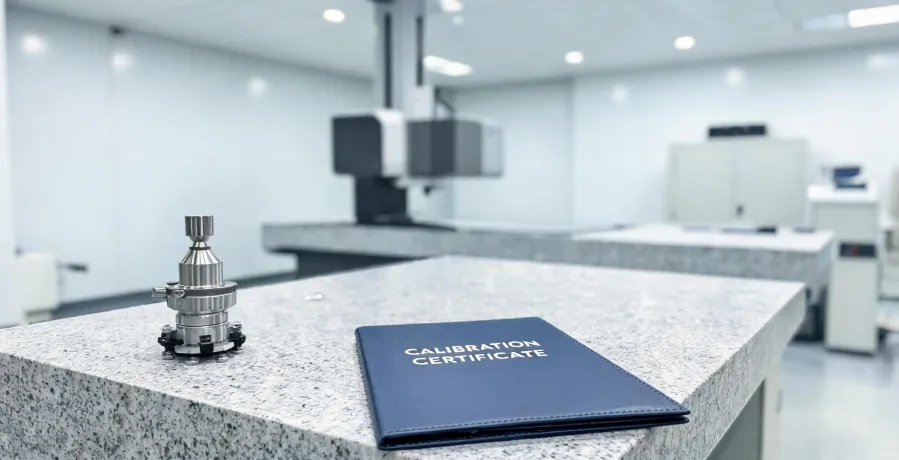
In my work as a quality compliance manager at a precision machining company, I review inspection setups, test reports, and first article results every day. Over 4 years in this role, I've approved or rejected roughly 4,000 part lots. One thing keeps coming up: people assume all measurement tools are interchangeable. They aren't.
Two Kinds of Precision, One Big Mistake
When you say "measurement" in a factory, half the room thinks of calipers and CMMs. The other half thinks of multimeters and clamp meters. Both groups are right, but they're working in different worlds.
Renishaw tools measure geometry and material properties. A Renishaw CMM fixture holds a part in a repeatable position so your coordinate measuring machine can inspect dimensions reliably. The Renishaw inVia Raman microscope identifies chemical composition, residual stress, and contamination at the micron level.
Fluke tools measure electrical behavior. A DC clamp meter reads current without breaking the circuit. An automotive multimeter diagnoses sensor voltages, ground faults, and parasitic drains.
You wouldn't use a multimeter to measure a bore tolerance. And you wouldn't put a CMM probe on a battery terminal. But the interesting part is what happens when people buy the wrong version of the right tool.
Dimension 1: What You're Actually Measuring
The Renishaw systems I rely on are built for repeatability. A CMM fixture kit positions a machined bracket exactly where it needs to be, every time. If your fixture flexes, your CMM gives you a false reading—and then you reject good parts, or worse, approve bad ones.
The inVia Raman microscope is a different kind of animal. It's not measuring size; it's measuring light scattering to determine material properties. I've used ours to confirm that a "contaminated" batch of medical components was actually a mold release issue. That saved a $22,000 rework.
Fluke's world is electrical. A DC clamp meter measures current through a wire without touching the conductor. That's essential for automotive work, where you can't always disconnect a harness to insert a meter in series. The automotive multimeter includes features like tachometer signal reading and low-impedance voltage measurement, which help avoid false readings on ghost voltages.
So the first comparison isn't "which is better." It's "which do you need today?"
Dimension 2: Accuracy and Resolution
This is where the comparison gets interesting—and where I made my rookie mistake.
In my first year, I made the classic specification error: assumed "standard" meant the same thing to every vendor. I used a Fluke multimeter to check the resistance of a heater coil, then tried to compare that number to a dimensional tolerance on the print. That's a category error. A DMM measures electrical resistance in ohms, not geometry.
Renishaw specs are quoted in microns and sub-microns. A CMM fixture made from aluminum with precision locating pins gives you repeatability in the single-micron range. The inVia Raman microscope offers spatial resolution below 1 µm and spectral resolution that lets you distinguish between similar polymer compounds. That level of detail matters when you're qualifying materials for aerospace or medical devices.
Fluke multimeters are accurate too, but in a different sense. A typical Fluke 87V measures DC voltage to 0.05% + 1 digit. That's plenty for diagnosing a crankshaft position sensor. It's not enough to tell you whether a shaft diameter is within 0.005 mm.
Here's the counterintuitive conclusion: for electrical fault-finding, a $400 Fluke can be more useful than a $200,000 Renishaw system. Not because of the spec sheet, but because it's the right tool for the job. The most precise measurement is useless if it's the wrong type of measurement.
Dimension 3: The Real Cost of "Good Enough" Tools
My stance is simple: value over price. The cheapest option almost never costs less once you count the fallout.
Consider Renishaw CMM fixtures. In Q3 2024, I documented a shop that saved 30% on knock-off clamping kits. Then a fixture flexed during a critical inspection, the CMM read out of tolerance, and the shop reworked 100 parts that were actually fine. The labor cost alone wiped out the savings. One rework event cost them $1,500 in machining time and inspection hours. The cheap fixture had saved them $120.
The same logic applies to electrical tools. A generic DC clamp meter might read 15 amps when the real current is 17.5. In automotive diagnostics, that's the difference between a working alternator and a failing one. You replace the alternator, the problem stays, and the customer pays for hours of wasted diagnosis.
That's not a hypothetical. Over 4 years, I've seen three separate incident reports where technicians trusted uncalibrated multimeters. Two of those resulted in misdiagnosed faults and a $680 unnecessary part replacement.
I'm not saying you need the most expensive option. But I am saying this: total cost includes your time, your rework, and your reputation. A lower quote that costs you a redo isn't a saving.
Dimension 4: Workflow Differences You Can't Ignore
In a production environment, these tools serve different parts of the workflow. My team uses Renishaw fixtures on the CMM for first article inspections and PPAP work. We use the inVia Raman microscope for failure analysis and material verification. And when we troubleshoot equipment on the floor, we grab a Fluke automotive multimeter or a DC clamp meter.
That's why "Renishaw vs. Fluke" is a false choice. They're different instruments for different questions. But there's one workflow question that comes up constantly in my inbox: how to use Fluke multimeter correctly.
Here's the short version:
- Turn the dial to the correct function. For DC voltage, select V with a straight line above it. For resistance, select Ω.
- Insert the black lead into the COM jack and the red lead into the V/Ω jack.
- Touch the probes to the circuit. The meter will auto-range and show a reading.
- For current, use a clamp meter and place the clamp around a single conductor, not the whole cable.
That's basic, but the number of times I've seen a lead in the wrong jack is shocking. (Should mention: I did this myself once in 2022. Blew the fuse on a bench meter. $35 lesson.)
Oh, and don't forget the meter's input limits. A meter rated for 600V CAT III isn't meant for high-energy distribution panels. Per IEC 61010, you need to match the meter category to the environment. If you need that, spend more. The correct tool for the application is always the cheaper option in the long run.
Which One Should You Choose?
If you run a machine shop or a quality lab, invest in proper Renishaw fixtures and, if your material mix demands it, a Raman system. According to Renishaw (renishaw.com), fixture repeatability is a key factor in CMM measurement uncertainty. They're not cheap, but the cost of a failed inspection is much higher.
If you work on vehicles, production equipment, or electrical systems, buy a quality Fluke multimeter and a DC clamp meter. The peace of mind from a reliable reading is worth every dollar over the bargain bin price.
If you're a quality manager like me, you'll end up with both. I know our $80 cheap multimeter sat in a drawer for two years before I finally threw it out. The replacement Fluke paid for itself within a month.
So glad I pushed for that purchase. Almost went with the $50 model instead, which would have missed the low-impedance mode we needed for a recurring sensor issue on one of our press lines. That one feature has saved us at least 10 hours of troubleshooting since 2024.
Bottom line: match the tool to the measurement. And when you're tempted to save money on the price tag, remember what I learned the hard way—there's no such thing as a good enough measurement when the part's already in the customer's hands.