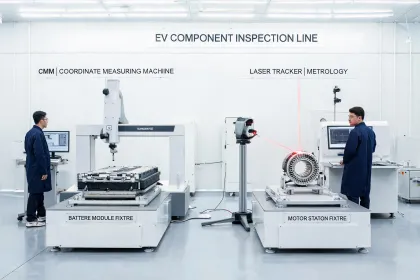
Automotive & EV
CMM, vision, and laser-tracker inspection across body-in-white, gigacasting, battery module and motor stator workflows.

Renishaw industry support begins with the use case, because each environment changes what evidence must travel with the instrument. A CMM probe in aerospace inspection, a roundness tool in mold qualification and a Raman microscope in device review may share a selection discipline, but each one has a different audit pressure.
CMM, vision, and laser-tracker inspection across body-in-white, gigacasting, battery module and motor stator workflows.
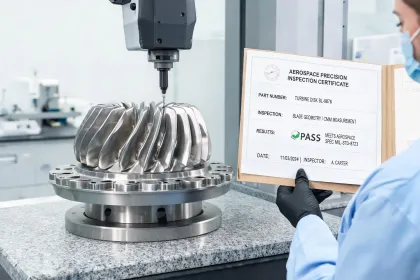
ISO 10360 probing-error qualification, micron-class blade and turbine-disk inspection with NIST traceability.
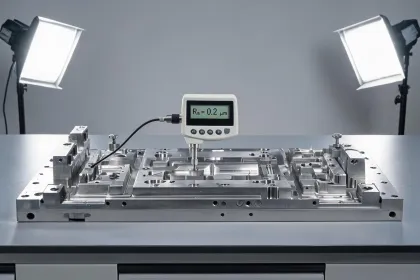
Roundness, form, and surface-roughness testing in mold qualification and die-set acceptance.
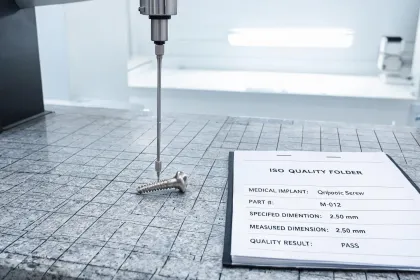
Implantable and disposable-device dimensional verification under IATF/ISO 13485 traceability rules.
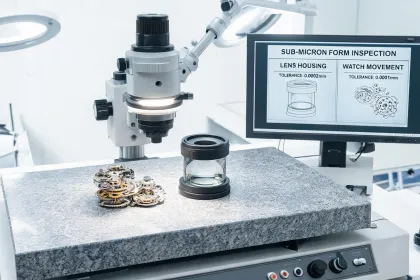
Sub-micron form and roundness inspection for lens housings, watch movement parts and optomechanical fixtures.
Automotive and aerospace teams often begin with a drawing package that moves through several engineering groups. The inspection method must therefore explain why a probe head, laser tracker or surface check is appropriate, and the certificate record must remain attached when the part moves from prototype to production release.
Medical and analytical workflows place heavier pressure on documentation language. The chosen instrument has to support sample-handling rules, internal quality review and external audit expectations. A clean selection note prevents the final evidence file from becoming a reconstruction project.
Mold, die, watchmaking and optics teams often face small features, polished surfaces or tight fixture envelopes. The recommendation has to show not only which tool can measure the part, but also how repeatability will be protected after the equipment leaves the lab.
Across all five industries, the buying question is rarely "which instrument looks closest to the keyword." A stronger question is "which measurement route can survive the production environment and still produce the proof our team needs." Renishaw's content structure keeps that question visible. Industry cards name the application, product pages keep to approved categories, service content explains calibration timing, and contact forms ask for the information that determines evidence quality. This creates a practical route for teams that have to coordinate engineering, quality and procurement without forcing every industry into the same generic story.