
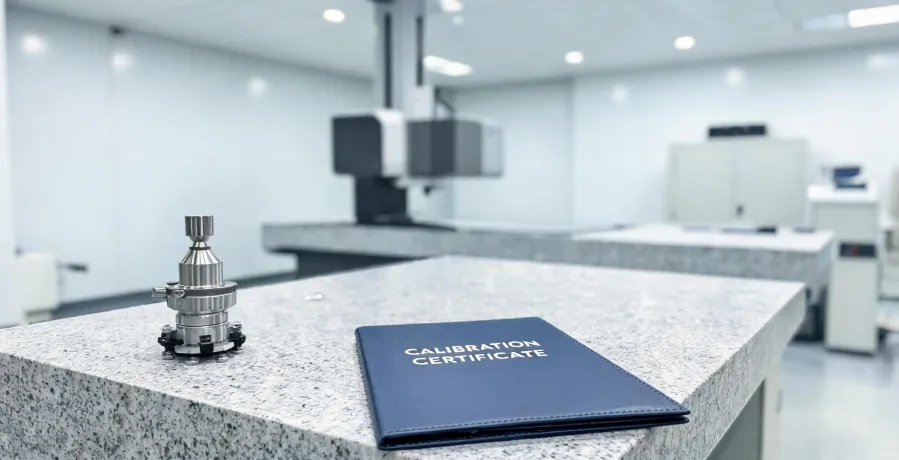
I'm the quality manager at a mid-sized aerospace supplier. In early 2024, we were in the middle of a $2.4M production run for a new customer—a first-time supplier approval that took nine months to earn. The parts were flight-control housings with tolerances measured in tenths of a thousandth. We had ten days to deliver after final inspection. That's when our Renishaw REVO 5-axis CMM system started giving us inconsistent results.
Let me be clear from the start: this isn't a story about a bad CMM. It's not about a bad Renishaw encoder. It's about how I nearly spent $2,800 on a replacement part that wasn't broken, and how the real culprit turned out to be a sensor most people walk past every day: the hydrostatic level sensor.
Actually, let me rephrase that. The sensor wasn't the villain. The villain was my assumption that the most expensive component is the most likely to fail.
The Job That Started It All
We installed the Renishaw REVO 5-axis CMM system late in 2023. If you're not familiar with it, the REVO is a 5-axis measurement probe that moves continuously along five axes, which lets the CMM measure complex internal features without reorienting the part. We chose it because the new contract involved bores, undercuts, and compound angles that would've taken forever with a traditional touch-trigger probe.
The first two months were smooth. Inspection time per part dropped about 35%. Our CMM programmer was happy, the operators were happy, and I started to believe we'd made the right call. We even passed the customer's own quality audit.
Then part 81 of 300 failed a bore check by +0.004 inch. We re-ran it and it passed. I chalked that up to a thermal effect—parts were machined in the morning and measured in the afternoon, so the temperature could easily shift by a few tenths. But part 87 failed. Then part 92. Intermittent failures are the worst kind, because they force you to question every part you've already accepted.
The First Sign of Trouble
I did what most quality managers do under pressure: I looked at the most expensive component first. The REVO's B-axis uses a Renishaw encoder to sense its angular position. In my head, an intermittent positional error had to be an encoder problem. I had a replacement Renishaw encoder in my cart, ready to place the order, before I'd even opened the machine's diagnostic log.
Look, that was a rookie mistake. Let me rephrase that: I let the deadline push me into a conclusion without evidence. The diagnostic log did show a “B-axis position error” twice, but a position error is a symptom, not a cause. The encoder might have been fine. The amplifier might have been fine. Something else might have been flexing the structure by a fraction of a degree.
A smarter engineer than me asked, “Did you check the machine's level?” I hadn't. The CMM's granite table sits on pneumatic isolators, and those isolators rely on a hydrostatic level sensor to keep the entire structure within a few arcseconds of true level.
I remember thinking, “That sensor can't be the problem. It's just a switch.” That's exactly the kind of thinking that creates hidden failures.
Following the Signal Chain
Let me explain what a hydrostatic level sensor does, because I didn't fully appreciate it until this incident. The sensor uses liquid-filled vessels connected by tubes, with a pressure transducer at the bottom of each vessel. As the machine settles or tilts, the liquid height changes. The transducer detects that change and sends a signal to the isolator controller, which adjusts air pressure to bring the system back to level.
If the sensor drifts out of calibration, or if air gets trapped in one of the tubes, the isolator system still works—it just works at the wrong level. There's no alarm. No warning light. The CMM might be off by 0.001 or 0.002 degree, and for most work that wouldn't matter. But on a 5-axis system with Renishaw encoders measuring to sub-micron repeatability, a slight tilt changes the effective probe orientation enough to cause intermittent failures.
That's what we were seeing. The error appeared only when the REVO approached the critical bore from certain angles. It was a geometry problem, not a probe problem. To confirm, we ran a repeatability study: the same part, the same program, ten times in a row. The results were split—six passes and four failures, with failures concentrated at one specific approach direction.
That pattern told me the probe head was fine. The Renishaw encoder was fine. The machine was moving to slightly wrong positions only on certain axes, which is what a tilted base would do.
Why the 87 True RMS Multimeter Earned Its Keep
Before we condemned the hydrostatic level sensor, I had to prove it was sending an incorrect signal. That's where my 87 true RMS multimeter came in.
I know “true RMS” gets thrown around a lot, but it matters in a plant like ours. The power in our CMM control cabinet isn't a clean sine wave—there's variable-frequency drive noise from pumps, motors, and other equipment. A low-cost multimeter estimates AC values using an averaging formula, which can be wildly inaccurate when the waveform is distorted. The 87 measures the actual heating value of the waveform, so I could trust the numbers without second-guessing the meter.
I measured the sensor's output two ways: at the sensor terminals and again at the controller input. The sensor was sending 11.82 mA. The controller was receiving 11.53 mA. A 0.29 mA difference doesn't sound like much, but in a 4-20 mA loop, that's roughly 1.8% of full scale. For a level sensor covering a 10-inch range, that's about 0.18 inches of error—far more than the CMM's leveling system was designed to correct.
That measurement gave us the evidence we needed. We didn't order the replacement Renishaw encoder. We ordered a new level sensor instead.
IFM vs. Omron vs. Keyence: What I Actually Found
Choosing the replacement took longer than diagnosing the original problem. Our plant uses sensors from IFM, Omron, and Keyence in different areas, so I tested all three for this application. I went back and forth for a week. On paper, they all met the specs. In practice, they were very different.
- IFM sensors: The build quality is the best of the three. Metal housing, solid connectors, and the installation guide reads like it was written by an engineer who actually works in a factory. The downside is the software, which feels dated and takes multiple reads to understand. But for a sensor that mostly sits there and does its job, I'll take robust over fancy.
- Omron sensors: The configuration software is genuinely good, and the auto-calibration feature saved us time during setup. The housing, though, is plastic. One unit cracked when we over-tightened it—probably installer error, but it made me nervous about long-term durability in a location that's hard to reach.
- Keyence sensors: The most polished option. The display is clear, the menu is intuitive, and their support team picked up the phone immediately. It's also the most expensive, and for a simple level-monitoring application, the extra features felt like overkill.
We chose IFM. Why? Because the sensor sits under the CMM in a cramped spot. I'd rather fight a clunky menu twice a year than climb under a machine to replace a cracked plastic housing. But I won't tell you IFM is objectively better. If your priority is smooth integration with a modern PLC, Omron's software advantage is real. If you want the friendliest user experience and budget isn't a concern, Keyence is the one.
This is the same conclusion I've reached with CMM systems. The Renishaw REVO 5-axis CMM is an incredible tool for complex, high-volume inspection. If you're a small shop measuring simple parts, a manual CMM or even a good comparator will do the job for a fraction of the investment. There's no shame in matching the tool to the task, not the other way around.
What I'd Do Differently
This incident cost us two full days of troubleshooting. If I could go back, I'd change three things.
Start with the cheapest diagnosis. I nearly ordered a $2,800 Renishaw encoder before checking the machine's leveling system. A 30-minute check of the hydrostatic level sensor would've saved us two days of downtime.
Trust your meter, but verify your assumptions. The 87 true RMS multimeter gave me the reliable reading I needed. But the meter can only tell you what's true if you're measuring the right thing. I was measuring the sensor signal because I'd stopped to ask better questions.
Ask the dumb questions. The engineer who asked about the machine's level wasn't being obvious. He was being thorough. I've since added the level sensor to our pre-run checklist, and it will stay there.
In the end, we replaced the sensor, re-leveled the CMM, and re-inspected all 300 housings. They passed. The $2.4M order shipped on time, and we avoided an unnecessary replacement part.
That's the part of this job I still love: taking a messy, intermittent problem and reducing it to a single root cause. It's not glamorous. It's not high-tech. But it's honest engineering. And it starts with trusting the whole signal chain—not just the shiny component on top.