
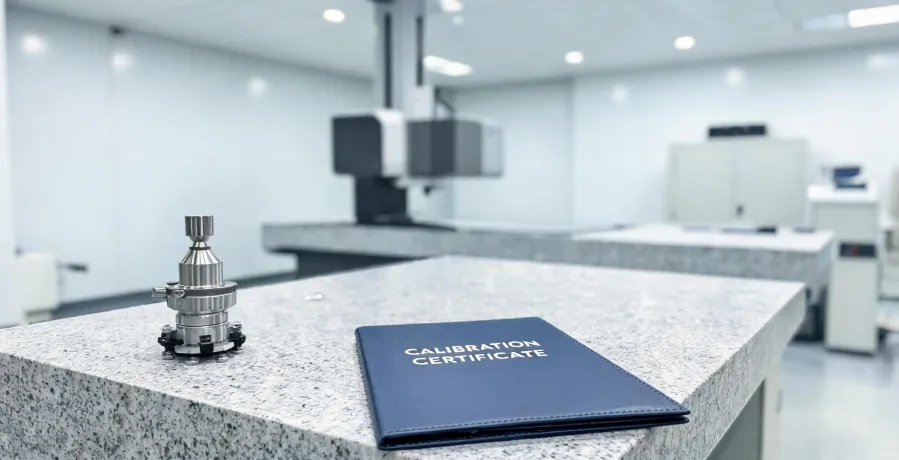
I got the call at 2:15 on a Thursday. A quality engineer needed a Renishaw CMM probe tip in his hand by 7 a.m. Friday. Normal lead time from the distributor? Three days. The spare stylus had cracked during a first-article inspection, and a customer audit started Monday.
I've handled more than 200 emergency replacement and calibration requests over the past eight years. That call was ordinary except for one detail: the engineer had also bought a set of compatible probe tips the week before from an online marketplace. They looked right. They didn't fit the way the genuine Renishaw tip fit, so they sat in a drawer. The rush order came anyway.
In my role coordinating emergency replacements for manufacturing and lab clients, I keep coming back to the same comparison. Not genuine versus compatible. The comparison that matters is planned replacement versus emergency replacement. They look identical on a purchase order. They cost completely different amounts of money.
A planned replacement feels like an expense. An emergency replacement feels like a crisis. But only one of them has the power to stop a production line.
Dimension 1: What counts as cost
Most buyers who wait to replace damaged equipment are trying to save money. That logic only works if you compare the price of the part. Once you compare the cost of the event, waiting looks different.
The full total cost of ownership model includes:
- Part price plus freight — standard or overnight
- Labor to remove, install, and document the swap
- Calibration or verification after the change
- Downtime on the CMM, the test bench, or the process line
- Possible re-inspection or rework if measurements had already started drifting
The part is usually the smallest line item. Overnight freight can cost more than the part itself. An after-hours service call can cost several times more. And if the failing component already produced bad data, the re-inspection cost can exceed a year's worth of replacement tips. The lowest quote on a replacement component is not the same as the lowest total cost. It never was.
Dimension 2: What counts as accuracy
Most operators focus on the visible part: the ball, the thread, the stated diameter. That's understandable. The factor they miss is verification after the swap. A brand new Renishaw CMM probe tip can be perfect and still cause measurement error if the probe is not qualified after installation. CMM software requires a stylus qualification against a reference sphere. Skip it and your readings can be off by microns.
Planned replacement includes that step because nobody is in a rush. Emergency replacement often skips it because the operator is under pressure and the part is already late. That's where a small maintenance decision becomes a quality disaster.
Here's the conclusion that surprises people: I'm not going to tell you that all compatible stylus options are junk. I've seen well-made compatible styli measure fine, and I've seen genuine parts arrive damaged. The real difference is what you can prove. A genuine Renishaw stylus comes with known tolerances, a datasheet, and a manufacturer who will answer questions when something looks odd. That traceability matters in aerospace, automotive, medical, and any quality system where uncertainty budgets are documented. It might not matter if you're measuring a plastic bracket for a hobby project. Know which situation you're in before you buy.
The same logic applies to spectroscopy. A Renishaw Raman microscope is a high-end instrument, but it still depends on routine validation. A quick check against a silicon reference gives a Raman band at 520.7 cm⁻¹ and tells you whether the instrument is still aligned. Planned verification takes minutes. Emergency discovery after three weeks of collected spectra takes much longer to fix.
Dimension 3: What counts as time
The real question isn't 'can you get it here fast?' It's 'why did you need it fast in the first place?'
When I'm triaging a rush order, the first thing I ask is not the part number. It's the deadline. Is the machine down? Is an auditor in the building? Is a shipment waiting on a measurement report? The answer determines whether we can use ground freight or whether someone is paying an embarrassing amount for an overnight box.
In March 2024, I watched a client lose an entire weekend because a flowmeter verification was scheduled for the week after their planned maintenance shutdown. The meter drifted. They discovered it during a routine process check on Friday. The rush calibration, the expedited reference standard, and the overtime all landed on the following week's budget. The planned shutdown had already passed. That sequence is painfully common.
Planned replacement lets you choose the moment. Emergency replacement lets the equipment choose. Those are not the same thing.
Practical replacement triggers for five instruments
Renishaw CMM probe tips
Renishaw CMM probe tips look simple, but they accumulate damage that is hard to see. A ruby ball can chip. A ceramic shaft can bend. A stylus that passes a visual check can still deform under measuring force after thousands of cycles. Make it a habit to inspect each stylus before a critical run, qualify the probe after any stylus change, and keep a spare for the stylus you use most. When a tip has touched a workpiece unexpectedly — a crash, a fast move, a missed clearance — replace it before the next inspection, not after.
Renishaw Raman microscope
A Renishaw Raman microscope gives excellent results when its optical alignment is stable. That stability should be checked, not assumed. Use the instrument's silicon reference or an equivalent known standard at a set interval — monthly is common for labs running daily — and always after the instrument is moved or serviced. If you have spectra that look slightly wrong, the instrument is telling you something. Listen before you re-run the samples.
Handheld meters, including the 177 multimeter
The 177 multimeter doesn't get the same attention as a CMM or a Raman system because it's small and inexpensive. But it still has a calibration interval — typically one year for most bench and handheld meters — and it has fuses that can blow without any obvious sign. A meter with a blown current fuse will still read voltage correctly. That's how the problem hides. Put handheld meters on the same calibration schedule as the rest of the electrical measurement chain.
Flowmeters
Flowmeters are the equipment most likely to fail quietly. A Coriolis meter can develop zero drift. An ultrasonic meter can lose signal strength as the pipe wall scales. The process reading drifts by one or two percent, and nobody notices until the material balance stops adding up. For flowmeters, the planned move is periodic verification against a master meter or a gravimetric check. Do it during planned shutdown. If you wait until the process data looks wrong, you've already got a batch of questionable product to investigate.
HPLC columns: Agilent and other brands
'How often to change your columns hplc agilent?' is a regular question. The honest answer is that there is no fixed injection count that works for every column. In reversed-phase methods with well-prepared samples and a guard column, labs often get somewhere around 1,000 to 2,000 injections before a column starts to degrade. Dirty samples, high aqueous mobile phases, and harsh pH can cut that number dramatically.
Column replacement should be driven by performance, not by a calendar. Watch for rising backpressure, tailing peaks, loss of resolution, or retention time drift that system suitability can't explain. When a column no longer meets your method's acceptance criteria, change it. If you always change at the first sign of trouble, you lose some column lifetime. If you never change until the separation fails, you lose batches. The planned strategy is a guard column, a performance log for each column, and a spare column available before the current one dies during a Friday night sequence.
So which strategy wins?
Planned replacement wins in almost every case where the instrument is critical and the measurement report has to be right. That's not an exciting conclusion, but the practical version is less obvious.
The best plan is not a fixed date on a calendar. It's a trigger and a buffer. Set the condition that tells you when to replace something. Keep the replacement part in stock. Verify the instrument after the swap. If you do those three things, it doesn't matter whether the replacement happens next week or next year.
The buyers who get burned are the ones who treat spare parts as an unnecessary expense. A $100 stylus on the shelf looks like wasted money until the line stops and the overnight freight invoice arrives. The same goes for a Raman calibration check, a meter fuse, a flowmeter verification, or a spare HPLC column.
I now calculate total cost before making any of these decisions. Part price is only the first line. Time is a cost. Risk is a cost. Bad data is a cost. Once you count them all, the 'responsible' option is usually cheaper. It just requires buying before the panic starts.