
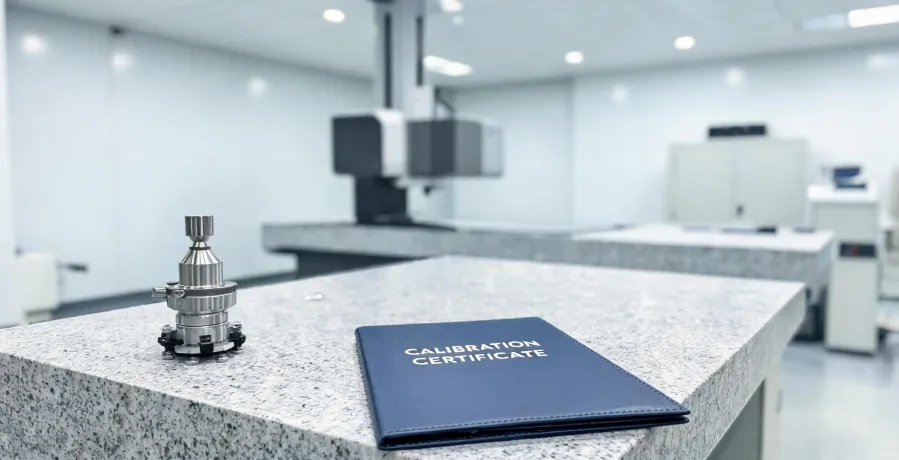
I remember the sinking feeling. It was March 2024, 36 hours before a major client acceptance test for a 5-axis CMM system we'd just retrofitted. We were missing a critical set of probe extensions. The standard ones from our usual Renishaw distributor? They'd take four days. The budget printer I'd tried to save $200 on? Their stuff didn't arrive, and when it did, the threads were off by 0.2mm.
Not ideal. Serviceable, but for a high-precision acceptance test? It was a non-starter.
I didn't fully understand the value of a genuine Renishaw BISS-C encoder versus a generic 'compatible' option until that March failure. It's not just about accuracy specs on paper. It's about knowing your interfaces will mate, your cabling will work, and your probe tips won't wobble at the critical moment.
People think expensive vendors deliver better quality. Actually, vendors who deliver quality can charge more. The causation runs the other way. The assumption is that rush orders cost more because they're harder. The reality is they cost more because they're unpredictable and disrupt planned workflows.
How It Started
In my role coordinating metrology equipment for a mid-sized contract manufacturer, I oversee about 60 CMM probe heads and a dozen Raman microscopes. We do a lot of rush work for automotive and aerospace clients. In January 2024, we landed a lucrative contract.
Our client, a Tier 1 supplier, needed a custom measurement fixture integrated with a new 1260 HPLC system for in-process quality checks. The deadline was tight—just under three weeks. We had most of the core components: the CMM, the fixturing base, the Renishaw controller. But the probe extensions were the sticking point.
My finance director, looking at the numbers, asked why we were paying a premium for 'brand name' Renishaw parts when there were Chinese alternatives at half the cost. 'Just get the probes from their catalog,' he said. 'They all measure the same.'
Bottom line? I didn't push back hard enough. I agreed to try the budget route for those extensions. We ordered a set of M4 thread extensions that claimed to be 'compatible with Renishaw CMM probes.' Price: $80 per extension vs. Renishaw's $160. I saved $200 across the set. Seemed like a no-brainer.
The Turning Point
Everything arrived on time—or so the tracking said. The package went missing for two days. We finally got it. That's when the panic started.
When I'm triaging a rush order, I check three things: Time remaining, feasibility of the fix, and the absolute worst-case scenario. At 36 hours out, the worst-case was a $3,000 penalty clause for missing the acceptance window. The client had already booked the facility. A delay wasn't just money—it could lose us future work.
I test-fitted the new probes. The threads were tight, then binding. A quick gauge check showed the pitch was off by 0.2mm. Not catastrophic for a one-off part, but for a CMM probe that needs to repeat measurements to within microns? It's a disaster.
The question isn't whether you can save $200 upfront. It's whether your $80 'savings' ends up costing you $3,000 in penalties, not to mention the reputation hit.
The Fix
I called our regular Renishaw supplier at 4 PM. 'I need these extensions by tomorrow noon. What do I need to do?' The rep didn't flinch. 'We'll overnight them from the regional warehouse. Base cost is $160 per extension. You'll pay $40 extra in express shipping, so $200 for the set. Total: $360.'
Better than 'we can't help you.' So, we paid the $200 in rush fees on top of the original $320 base cost for genuine parts. Total cost for extensions: $520 instead of the $160 I'd originally budgeted? Actually, no. The base was $320 for genuine, I spent $80 on the cheap ones, so $400 in parts, then $200 in rush fees? Wait—I'd already paid $80 for the bad ones (which we couldn't return). So the total was $80 (bad parts) + $360 (express genuine parts) = $440. I saved $200? No, I spent $440 instead of $320. Plus the two hours of engineering and QC time to validate the bad parts. Let's call it $480 wasted.
The express parts arrived at 10:30 AM. I should add that our own R&D team was skeptical—they'd flagged the budget vendor before. I should have listened.
The acceptance test passed. But barely. And only because my team worked through the night.
A Lesson Learned the Hard Way
So what's the takeaway? For me, it wasn't just about extension probes. It crystallized how I think about any metrology purchase—whether it's a Renishaw BISS-C encoder for a new build, a Raman microscope adapter, or even something as simple as a mouse adapter cable.
Per ISO 10360, coordinate measuring machines require specific environmental and equipment standards. But your supply chain standards? That's on you. My company now has a formal policy: 'No critical path metrology components from unverified third parties.' Period.
Why does this matter? Because the cost of failure in precision engineering is rarely the component price. It's the downtime. The verification cycle. The client relationship.
I've handled over 300 rush orders in 12 years. In my experience, the lowest quote has cost us more in about 50% of cases. That $200 savings? It's a gamble. Sometimes you win. But when you lose, you lose big. In 2023, we lost a $15,000 contract because a budget encoder failed after 90 days. The client didn't care about our savings. They wanted reliable measurement.
Per USPS pricing effective January 2025, a First-Class letter costs $0.73. That's not relevant to metrology, but the principle holds: standard costs are predictable. Rush costs are a penalty for bad planning.
Bottom Line
The vendor failure in March 2024 changed how I think about backup planning. One critical deadline missed, and suddenly redundancy didn't seem like overkill.
I now have a go-to list of verified suppliers for every type of Renishaw component—CMM probes, laser interferometer parts, encoder heads, you name it. I even keep a spare set of common probe tips and stylus extensions.
Oh, and my finance director? He agreed that from now on, any part that affects CMM performance gets sourced from Renishaw or their authorized distributors. No more 'compatible' experiments during a rush job.
Call me old-fashioned. But when a $3,000 penalty is on the line, the cheapest option is not a gamble I'm willing to take again.