-
Who This Checklist Is For
- Step 1: Define What You're Actually Measuring
-
Step 2: Compare Total Cost, Not Just the Quote
-
Step 3: Verify the Paperwork Before You Commit
-
Step 4: Plan Training Before the Box Arrives
-
Step 5: Buy One Pilot Unit Before Scaling
-
What Most Buyers Forget
-
Quality Measurement Is a Brand Decision
Who This Checklist Is For
Look, I'm not an engineer. I'm the person engineers come to when something needs to be ordered. My office handles procurement for a 400-person manufacturing site: CMM probe tips, a Renishaw Agility CMM, a Renishaw Raman microscope, thermal cameras, you name it. If you're also the non-technical buyer in the middle of these requests, this checklist is for you.
There are five practical steps. I've been using them since I took over purchasing in 2020, and they work for everything from a $300 thermal camera to a capital quote that says "contact us for pricing." They've saved me from at least two expensive mistakes, and they should save you one too.
Step 1: Define What You're Actually Measuring
Before you look at a single spec, ask the team to explain the measurement in plain English.
For a Renishaw Agility CMM, the use case is usually high-speed scanning of complex parts. That's not the same as everyday dimensional inspection. If all your machinists need is periodic verification, you may not need the agility package—you need the right probe and software. For a Renishaw Raman microscope, the use case is materials chemistry: polymer IDs, contaminants, pharmaceutical formulations. If the request says "Raman microscope" but the team won't give you sample types, stop the quote process. Not all Raman configurations see the same things.
Thermal camera price depends on the same question. A basic spot pyrometer can cost $200-$600. A handheld imager for electrical panels starts around $2,000-$4,000. A radiometric, utility-grade thermal camera can run $5,000-$15,000. If the team only needs to find hot spots, don't buy a research-grade model. But if you're using the images for compliance reports, buy the one that stores radiometric data. (As of January 2025, anyway—verify current prices before you budget.)
Don't ignore the water meter question
Here's a strange but true part of my job: I've had to learn how to read a Sensus water meter. It's not a trick question. Sensus meters use different registers—cubic feet, gallons, imperial gallons—and the difference can be a 7x error if you misread the unit. I caught a utility invoice that used gallons when the physical meter was reading cubic feet. That's exactly the kind of detail that makes a procurement person look good or look sloppy.
Step 2: Compare Total Cost, Not Just the Quote
Here's the thing: list price is not the real cost. What I mean is that setup, calibration, training, spare parts, and service response times all belong in your comparison.
Thermal camera price reference (publicly listed, January 2025):
- Basic spot pyrometer: $200-$600
- Entry-level thermal imager (non-radiometric): $1,500-$3,500
- Radiometric imager with report software: $3,500-$10,000
- Utility/industrial grade with NIST-traceable calibration: $10,000-$20,000
Prices vary by resolution, thermal sensitivity, and calibration. Verify current rates with your supplier.
If the request is for "1 thermal camera," don't assume one is enough. But don't assume you need four, either. I always buy one first, test it with the person who will actually use it, and then expand. One pilot unit answers more questions than a spreadsheet.
Renishaw Raman microscope pricing is not public, which is itself a warning. I ask for a formal quotation that states exactly what's included: laser wavelength, grating, microscope objectives, software licenses, installation, and training. If the quote says "options available" without a breakdown, it's not a quote—it's a fishing expedition.
Step 3: Verify the Paperwork Before You Commit
I only learned this after ignoring it once. A vendor with a great price couldn't provide a proper invoice. Finance rejected the expense report, and the $2,400 came out of our department budget. Now I ask for a sample invoice before I'll place any PO.
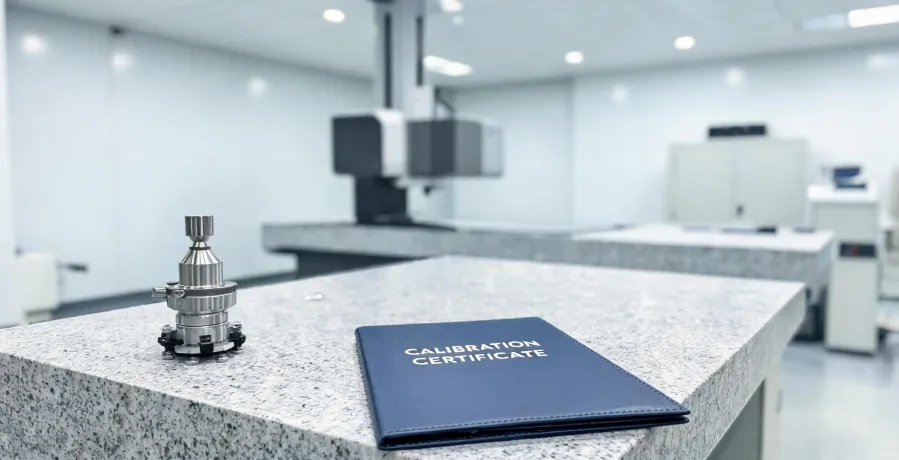
For measurement equipment, the paperwork matters even more. A Renishaw CMM probe is useless without a calibration certificate. A Renishaw Raman microscope needs wavelength calibration verification. A thermal camera used for compliance needs an NIST-traceable calibration record. If the vendor can't provide these documents, treat the quote as incomplete.
The documents I ask for upfront:
- Calibration certificate or declaration of conformity
- Delivery terms and expected lead time
- Warranty details and service response times
- Spare parts availability and replacement cost
- A sample invoice (seriously, do this)
And if you're managing facilities, the same logic applies to utility meters. Learning how to read a Sensus water meter means you can verify the ledger against the physical register. It's the same discipline as matching a packing slip to an order.
Step 4: Plan Training Before the Box Arrives
This is the counterintuitive step. Most procurement checklists end at delivery, but the equipment that changes a company's quality is the equipment people know how to use.
When I compared our departments' results with the same type of Raman microscope—same vendor, different operators—I finally understood why training is not a soft cost. One team produced publishable spectra; the other stored the instrument in a corner. The hardware wasn't the difference. The confidence and skill of the operator were.
For a Renishaw Raman microscope, training means sample prep, laser safety, fluorescence troubleshooting, and data interpretation. For a thermal camera, it means emissivity settings and image analysis. For a water meter, it means knowing how to read the numbers and report in the correct units. These are small investments. Skip them, and you'll pay for it in distrust when the first report looks wrong.
This is also a brand issue. The first report your team produces with a new instrument is a client impression. If the measurements are off, the client doesn't blame the operator; they blame your company. The quality of the output is the brand.
Step 5: Buy One Pilot Unit Before Scaling
Here's where my gut and the spreadsheet usually fight.
The spreadsheet said buy three thermal cameras at once to get the volume discount. My gut said start with one. The pilot camera arrived, and the team discovered the software didn't export to their report format. If I had ordered three, we'd have had three expensive paperweights. Now I buy one, pilot it, and only expand after it works.
I only believe this because I skipped it once. The vendor warned me about the compatibility risk. I didn't listen. The five units I ordered didn't fit the existing fixtures, and the replacement cost wiped out the discount. That mistake is why I'm stubborn about pilots now.
For major capital equipment, the same rule applies. Before buying a Renishaw Agility CMM, ask to run a demonstration with your own parts. If the vendor won't let you do that, treat it as a red flag. The brochure is not a measurement.
What Most Buyers Forget
A few final notes from the messy parts of my job:
- Don't assume "same as last time" is actually the same. A reorder is not a no-brainer; specifications change.
- Ask about calibration intervals before you buy. Thermal cameras and CMM probes need calibration eventually, and that cost belongs in your annual budget.
- If you're involved in facility operations, learn how to read a Sensus water meter before accepting a utility statement. A simple unit error can create weeks of disputes.
- Don't buy accessories before the base unit is proven. The $500 stylus set is only useful if the probe works in your measurement routine.
Quality Measurement Is a Brand Decision
At the end of the day, I buy measurement equipment for the same reason I buy anything else: to make the company look good. When you ship a part with a quality report, the customer assumes the numbers are right. That trust starts with the instrument, the calibration, and the training you didn't skip.
This isn't an argument for the most expensive option. It's an argument against the false economy of the option that doesn't meet the requirement. The right Renishaw system, the right Raman microscope, or even the right $4,000 thermal camera is the one your team can actually use and defend. That's the quality that becomes your brand.