
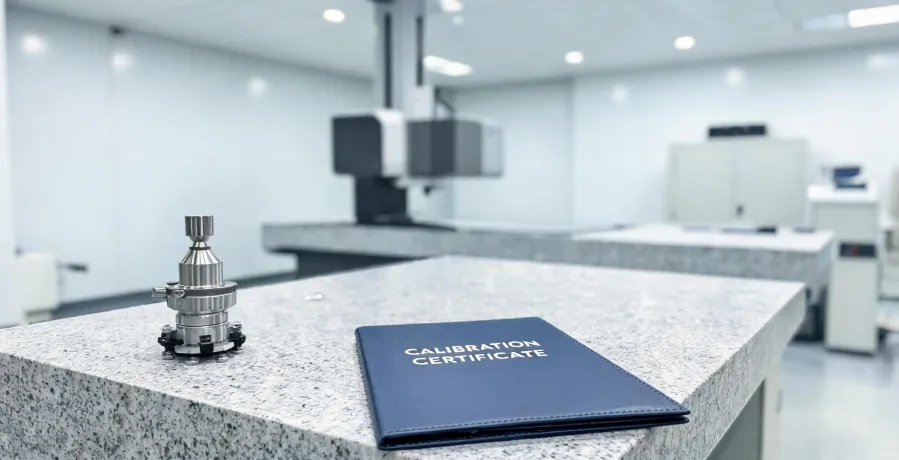
It was a Tuesday in March 2024. We'd just received a batch of twelve Renishaw laser encoders for our five-axis CMM retrofit. The calibration bench was running, the thermal chamber was stabilizing, and I was doing what I do best: checking the goods against the spec sheet.
Then the numbers didn't line up. The measured output from the encoder was off by 0.04% from the certificate. Not a huge deviation, but for a machine that measures parts to the micron, 0.04% is like a coffee cup being a quarter pound short. You notice it.
I'm the quality manager at a mid-size precision machining company. I review every critical component before it goes into our products—roughly 300 items a year. In 2024, I've rejected 7% of first deliveries due to spec deviations. That doesn't make us the nicest vendor to deal with, but in metrology, small errors become large lawsuits.
While I was staring at the encoder data, one of our new engineers asked why we'd ordered an insulation multimeter for the electrical bench. The same PO also included a 465 oscilloscope—an old analog Tektronix from the lab. "Are we going to use that for signal analysis?" she asked. I said yes, but we needed to check the probes first.
That was the beginning of a very humbling week.
The variable we forgot
We started troubleshooting the encoder output. Swapped cables. Checked grounding. Poured fresh coffee. Eventually I called Renishaw support—polite people, by the way. They sent me the exact test procedure from their encoder manual and asked one simple question: "What reference are you using?"
That's when I noticed it.
Our insulation multimeter was loaded with a calibration factor from 2022. The 2023 recalibration had changed the reference by 0.02%, and nobody updated the test procedure. The 465 oscilloscope's probe wasn't compensated either—the little adjuster screw on the end was off, so the waveform had a false ripple. We were chasing a precision problem with sloppy instruments.
The Renishaw laser encoder was fine. The certificate was fine. Our test gear wasn't.
I assumed the calibration certificate matched the as-shipped unit. Didn't verify my own test station. That mistake cost us a week of engineering time and several late-night emails to a vendor who didn't deserve them.
Back in 2022, we had a similar incident. Got a batch of 500 transducer cables where the shielding was visibly thin—about half a millimeter under spec. The vendor claimed it was "within industry standard." We rejected the batch and made them redo it at their cost. Now every contract includes minimum shielding thickness requirements. I should have known better than to assume my own proof was correct.
The Balluff question
Around that same time, someone asked me: "Is Balluff a good brand for sensors?" It's a question I hear a lot from procurement folks and even our own engineers. My honest answer has never been a clean yes or no.
Balluff makes solid sensors. Good repeatability, decent build quality, fair pricing. But in my experience, "good" depends on context. We ran a side-by-side comparison last year: a Balluff absolute sensor against a Renishaw laser encoder on the same test rig. Same resolution, same output protocol, same target speed.
The Balluff was excellent in a clean, temperature-controlled bench. Then we put it near a variable-frequency drive, and the signal started to wander. The Renishaw—because of its optical design—was less affected. Does that make Balluff a bad brand? No. It means we were using it in an environment it wasn't designed for.
When I compared those two sensors side by side, I finally understood why the details matter so much. The Renishaw encoder's signal was clean, stable, and repeatable. The magnetic sensor had about 12% more jitter in the same conditions. But the Renishaw costs roughly four times more. Is the extra cost worth it? Depends on what you're measuring.
This worked for us, but our situation was a climate-controlled metrology lab with regular calibration cycles. Your mileage may vary if you're putting sensors on a welding line or a dusty conveyor. I can only speak to my context.
What this means for your next purchase
The same logic applies to all measurement tools. An insulation multimeter is essential for checking motor windings and cable integrity, but it won't help you diagnose a noisy digital signal. A 465 oscilloscope can show you a basic sine wave, but for high-speed quadrature output, it's not the right instrument. You have to match the tool to the task.
Renishaw products like laser encoders and CMM probes are known for precision, but they're not magic. They need clean power, proper mounting, and realistic expectations. The same is true for any brand you're evaluating.
According to ISO 10012:2003, measurement management systems require calibration traceability and demonstrated uncertainty analysis. That means you have to prove your reference is accurate before you reject a supplier's claim. In our case, we almost flagged a good encoder because our own equipment was out of date.
The checklist I now use
Before any measurement component purchase, I walk through these steps:
- Verify what the spec actually means. Accuracy, resolution, and repeatability are not synonyms.
- Check your own test gear's calibration status first—don't assume the certificate on your wall is still valid.
- Ask about the operating environment: temperature range, EMI, vibration, humidity.
- Confirm output protocol compatibility (BISS-C, SSI, differential line driver) with your controller.
- If the cost justifies it, run a side-by-side test with another brand. Numbers beat opinions.
That last one is the one I now never skip. When I compared our Q1 and Q2 results side by side—same vendor, different specifications—I realized we'd been making decisions based on assumptions, not measurements. Brand matters, but context matters more.
So, is Balluff a good brand? Yes. Is a Renishaw laser encoder worth the premium? For our application, absolutely. For yours? You'll have to check your assumptions first.