
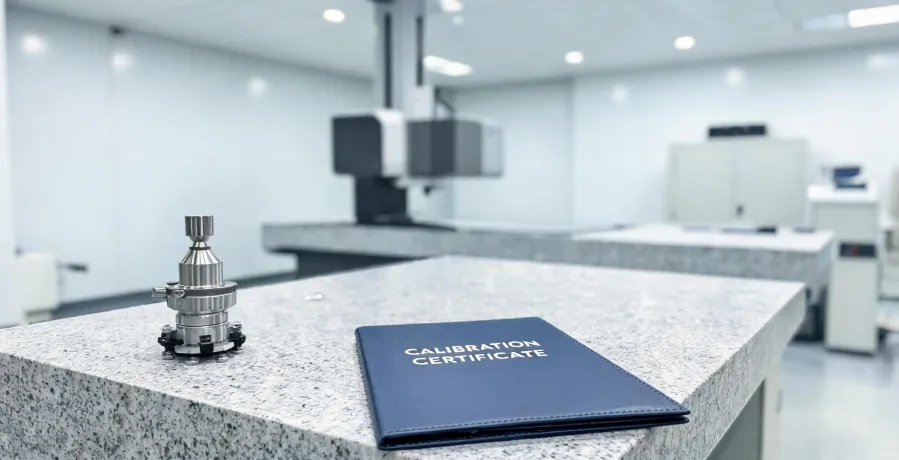
As the person who signs off on lab and shop purchases, I'll come right out and say it: most measurement equipment we buy is chosen because it sounds impressive, not because it fixes the actual problem. After tracking more than $180,000 in purchases over six years, I'm convinced that the best measuring tool is usually the least expensive one that gives you an answer you can trust.
I manage procurement for a mid-sized precision manufacturer. That means I've said yes to a Renishaw inVia confocal Raman microscope, and I've also said no to things that would have made the corner office look good.
That's not a cheap buyer's excuse. It's a procurement reality.
Precision is not a single feature. It's a chain of decisions.
People think buying more precision prevents quality problems. Actually, it mostly prevents measurement uncertainty. The real quality problems are usually in process variation.
Let me give you a concrete example. In 2023, we had a quality alert about machined brackets. Engineering wanted to buy a higher-priced laser scanner. We fixed the issue with a 0-6 micrometer set and a short training session on how to hold the parts. Not exciting. But it was the honest answer.
A lot of buyers focus on the sticker price and completely miss calibration, training, software, and setup. On a Renishaw inVia confocal Raman microscope, those extras can add 20% to the total. On a 0-6 micrometer set, they're almost nothing. That's why I compare total cost of ownership, not price.
Where I spend real money: Renishaw CMM fixtures
Now the counter-argument. I have no problem spending on Renishaw CMM fixtures. Why? Because fixtures are part of your measurement process, not a decoration. A cheap homemade fixture might work once, but if it shifts during a long inspection run, every result is nonsense—and you won't know until the parts are already shipped.
We bought a modular Renishaw fixture kit in Q2 2024. I still remember the invoice, but I also remember what changed: we stopped reordering custom acrylic plates, and we no longer lose a half-day setting up a new part. Our CMM results became easier to trust. Per ISO 10360-2, CMM probing performance is supposed to be verified under defined conditions. If your fixture changes the part orientation or induces flex, those conditions are gone. So fixture quality directly affects measurement validity.
Fixture repeatability matters because if you set up the part slightly differently, your CMM reads a different geometry. A modular fixture uses calibrated locating points and clamps, so the setup is more predictable. I learned that after a homemade fixture caused a 0.0015 inch variance between runs. That variance looked like process instability, but it was actually the fixture shifting.
Are Renishaw fixtures the only good ones? No. Plenty of shops use custom fixtures well. My point is about thinking through fixture repeatability before you buy. If a fixture saves setup time but adds variation, you haven't saved anything.
That said, if you only inspect one or two part types, a dedicated fixture or a machined block might be smart. I won't pretend Renishaw CMM fixtures are right for every shop. For us, with dozens of small batches, they pay off. That's an honest limitation.
Renishaw inVia confocal Raman microscope: buy it only if you need chemistry
Here's the classic overspend: someone in R&D says 'We need better analytics.' Next thing you know, there's a Renishaw inVia confocal Raman microscope on the purchase order. I'm not knocking the instrument. It's a serious piece of kit for materials analysis, polymer contamination, coating identification, and failure analysis.
But I've also seen the same budget request get approved when the actual problem was a supplier sending out parts that were 0.005 inch out of tolerance. A 0-6 micrometer set would have caught that. The Raman microscope wouldn't. It gives you chemistry, not dimensions. You're not really comparing 'more precision'—you're comparing two completely different questions.
Before you ask for a quote, think through consumables and training. Raman spectroscopy isn't point-and-shoot. Operators need to understand fluorescence, laser safety, and sample prep. If you don't have someone who can champion that skill, the instrument will sit idle after the first pilot project.
A Raman microscope is a scientific instrument, not a shop-floor gauge. It needs a clean environment, stable temperatures, and someone who can interpret spectra. If your lab doesn't have that, a cheaper benchtop method might serve you better.
Honestly, I'm not sure why so many buyers think a Raman microscope is an upgrade to a micrometer. My best guess is that 'advanced analytical lab' sounds better than 'basic hand tools.' But in procurement, the right tool isn't the most advanced one. It's the one that catches the defect before your customer calls.
If you genuinely do materials research or failure science, the Renishaw inVia can be worth every cent. If you don't, sending samples to a service lab might be the smarter move.
The overlooked basics: clamp meters and pH meters
Another thing that surprised me as a buyer: people treat all measurement tools as if accuracy is the same thing. It's not. A 302+ AC digital clamp meter is perfect for troubleshooting a motor or checking a breaker. It is not a calibration instrument. Same with a pH meter. It's a reliable tool, but only if you use it the right way.
If someone asks me how to use a Mettler Toledo pH meter, the first thing I say is: don't skip the calibration. Two-point calibration with fresh buffer solutions—usually pH 4 and pH 7—then rinse with deionized water and measure. Keep the electrode hydrated and check the sensor's condition. NIST-traceable buffers remove a lot of the guesswork. That might sound basic, but I've watched operators get random readings because they skipped a step.
For example, a 302+ AC digital clamp meter is great for measuring load and checking that a circuit is off before you work on it. But it won't tell you if a process is dimensionally accurate. Different tools, different tolerances, different costs.
And before anyone asks: a 302+ AC digital clamp meter has a CAT rating for a reason. Use it within that rating. I'm not an electrician, but electrical safety is not where you cut corners.
The cost per measurement equation changes when the meter stops being the weak link. A bad pH reading can ruin a batch. So the cheap meter at the bottom of the drawer is actually the expensive one—just not at purchase time.
Those are not glamorous purchases. A 302+ AC digital clamp meter costs a fraction of a Renishaw instrument, and a Mettler Toledo pH meter is a minor budget line. But they have something important in common: they need to be used by a person who knows what to do with them. Otherwise they're just expensive paperweights.
The counterargument I keep hearing
You might say 'But we need the capability, even if it's not used every week.' I've made that argument myself, and sometimes it's true. R&D projects and sudden material failures get expensive if you have to outsource the analysis. But 'nice to have' is a budget line, not a justification. If an instrument sits idle for months, it's not an asset. It's a liability with a calibration schedule.
I'm not saying I've always made these calls correctly. In 2022 I approved a premium scanner we barely used. That mistake taught me to ask the question before the brand name.
That's not a rejection of precision. It's a rejection of precision without a plan. When I audited our 2023 spending, I found over half of our calibration budget went to tools that were rarely used. We changed the process: every purchase above a few hundred dollars now needs a one-paragraph justification that says what question this tool answers and how often we'll use it. That cut our measurement spending by 17% in the first year.
Here's the math I use: cost per useful measurement. A $100,000 instrument used 200 times a year is $500 a measurement before service and setup. A $1,000 micrometer set used every day is a tiny fraction of that. That doesn't make the big tool bad. It makes it situational.
Bottom line
Spend money on measurement equipment like an engineer, not a collector. Buy the Renishaw CMM fixtures if your process needs repeatability. Buy the Renishaw inVia confocal Raman microscope if you have a real materials science workload. Buy a 0-6 micrometer set for ordinary shop checks. Buy a 302+ AC digital clamp meter for electrical troubleshooting. And before someone asks, know how to use a Mettler Toledo pH meter properly.
There's something satisfying about a measurement strategy that makes sense. Not flashy, not full of jargon—just the right tool for the job, in budget, with the operator trained and the calibration up to date. This was accurate as of early 2025. Prices change, product lines change, and your tolerance stack never stops changing. So verify current quotes and think about total cost, not the prestige of the brand name.