
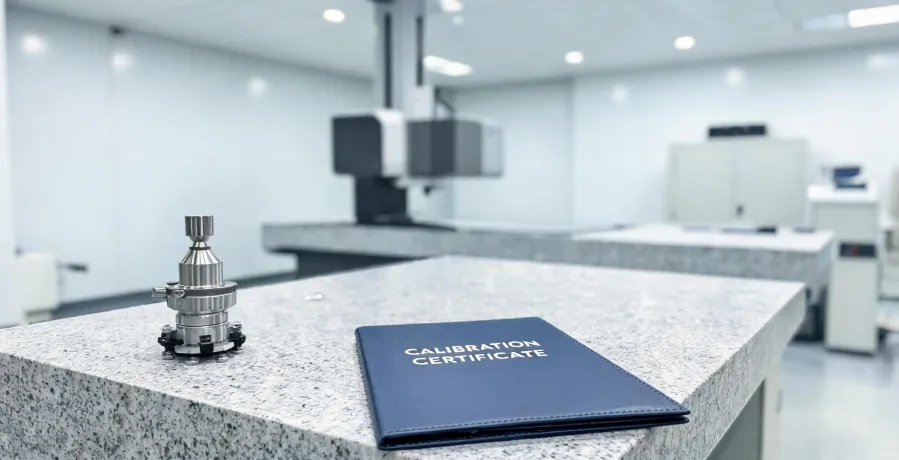
Here's the honest truth from seven years of buying measurement equipment for a precision machining facility: the cheapest measurement tools are always the most expensive ones you'll own. That $130 encoder wheel that fails on the production line is never cheaper than a $480 Renishaw encoder that runs for years. I've personally wasted roughly $46,000 learning this—12 documented purchasing mistakes, three failed vendor experiments, and one very expensive CMM re-certification.
Seven Years of Mistakes You Can Skip
I'm a QA engineer, and I've been handling metrology equipment orders since 2018. That also means I've been making purchasing mistakes since 2018. If I remember correctly, my first big one happened that March—I ordered third-party encoder wheels from an unknown supplier to save about 60% versus the OEM quote. It seemed flawless on paper. On the production floor, it was a completely different story.
These days, I'm the person who maintains our equipment procurement checklist. In the last 18 months, that checklist has caught 47 potential bad purchases that would have cost us everything from wasted hours to full line shutdowns. I'm not sharing this to sound impressive. I'm sharing it because I've made more than my share of dumb calls, and I'd rather you learn from them than repeat them.
The Oversimplification Trap: Identical Specs Aren't Identical
It's tempting to think you can compare spec sheets like you compare canned goods at the supermarket. Same resolution. Same output format. Same voltage. Same shaft diameter. Surely the cheaper encoder wheel is the smarter pick, right?
That oversimplification ignores the messy reality of manufacturing. The spec sheet doesn't tell you about the quality of the grating, the thermal stability of the substrate, or the adhesive that holds everything together. All the "same" specs, but wildly different performance under real conditions. I know this sounds kinda obvious in hindsight, but at the time the savings looked real.
In 2020, our rotary axes needed replacement encoder wheels. Renishaw quoted us around $480 per wheel. A third-party supplier offered what looked like the identical wheel at $130. It seemed like a no-brainer. We had two hours to decide before the quote expired, so I skipped my usual homework and made the call based on price alone.
We bought six, saving $2,100. For the first month, everything ran fine. By month three, two of the six wheels had started generating intermittent position errors. By month five, one had completely failed. The line went down for six hours while we scrambled for a replacement. At $2,500 per hour plus labor and emergency shipping, that one failure cost us around $16,000.
The surprise wasn't that the cheap wheels failed. It was how fast the "savings" vanished. A $2,100 discount turned into a $16,000 loss. That's when I started to understand total cost of ownership—not as a spreadsheet concept, but as a painful line item in our quarterly P&L.
Multimeter Price vs. the Right Tool for the Job
Here's a question I get all the time: "Which multimeter should I buy?" It's the wrong question. Most buyers focus on multimeter price and features and completely miss whether a multimeter is even the right class of tool for the job.
When we started diagnosing encoder signals in-house, I spent days comparing multimeter prices. I picked a solid $180 bench unit that handled voltage, current, and resistance more than adequately. But encoder diagnostics aren't about signal presence—they're about signal integrity. A multimeter tells you there's 5 volts on a line. It can't show you that the signal is noisy, that the edges are ringing, or that the encoder wheel is generating jitter at certain speeds.
We borrowed a Tektronix oscilloscope from the electronics lab. Learning how to use a Tektronix oscilloscope properly took me a couple of afternoons. And the first time I probed that encoder output, the problem was right there on the screen: a marginal signal with noise spikes crossing the logic threshold at specific speeds. A multimeter would never have shown me that.
Quick rundown of the test I now use for encoder channels:
- Connect the probe to the encoder's A channel output and ground.
- Set the vertical scale to the expected voltage—usually 5V.
- Adjust timebase and trigger until you see stable rising and falling edges.
- Look at the whole waveform for missing edges, ringing, or noise that shouldn't be there.
- Run the axis at multiple speeds, since intermittent failures often only show up at certain frequencies.
That fifteen-minute process solves more encoder mysteries than any spreadsheet of multimeter specs. The real question isn't "what's the multimeter price?" It's "what measurements do I actually need to make?"
The Renishaw CMM Probe Experiment That Backfired
In 2022, I made arguably my most embarrassing mistake. Our Renishaw CMM—a reliable TP20-based system—needed new probe tips. Genuine Renishaw CMM probes ran roughly $80 to $150 per tip. A third-party supplier offered compatible tips for about a third of that.
My gut said something was off. The vendor's support was slow, the documentation was vague, and their compatibility guarantee had enough fine print to wallpaper a bathroom. But the numbers said I'd save $750 on 15 tips, and I wanted to look good to my manager. So I overrode my gut.
For about two months, the tips measured fine. Then our CMM's repeatability started drifting. We checked everything—cleaned the scale feedback, verified the vibration isolation, ran calibration routines, re-qualified the probe. Nothing worked. On a hunch, I swapped in the last two genuine Renishaw tips we had in stock. Repeatability returned to spec instantly.
Turns out the third-party stylus geometry was technically within its stated tolerance, but the bending characteristics under measuring force were different enough to skew our results. This was invisible in the spec sheets, but very visible in the data. We had to bring in an outside lab to run the ISO 10360 verification, which added another $2,800 to the bill.
The "deal" ended up costing us $2,800 for re-certification plus around $4,000 in backlogged inspections. That's nearly ten times the $750 we'd saved. And no, it didn't impress my manager. What it did was create the discipline I now apply to every single purchase.
When Cheap Tools Are Actually the Right Answer
Now, I don't want you thinking I've become a premium-or-nothing kind of guy. That's the opposite oversimplification, and it's just as wrong. We still keep a $60 handheld multimeter in every toolbox for continuity checks and basic voltage verification. If a failure isn't going to hurt anyone or stop production, the cheap tool is the right tool. That said, our situation might not be yours—you have to run the numbers for your own operation.
The framework I use for any measurement equipment purchase:
- What failure mode am I trying to detect? A multimeter confirms signal presence. An oscilloscope reveals signal behavior. A CMM with calibrated probes measures geometry. Match the instrument class to the problem.
- What's the cost of that failure going undetected? If it's close to zero, buy the budget option. If it's a production stoppage or a bad part reaching a customer, the budget option is a false economy.
- What's the total cost of ownership? Purchase price, calibration, expected lifespan, support, and production impact. A Renishaw encoder looks expensive until you stack it against a single line shutdown.
- Who picks up the phone when things go wrong? Support availability is part of the price. This was the red flag I ignored with the third-party CMM probe vendor.
- Does this measurement affect a customer deliverable? If it does, you own the result. The tool is just part of your liability.
I've been burned enough times to stop trusting "identical specs" as a purchasing criterion. Spec sheets describe what a component should do. They don't describe how it's manufactured, how it behaves under temperature swings, or how the vendor will respond when it fails. Those are the details that decide total cost—and they're invisible when you're staring at a price list.
So, bottom line: stop comparing unit prices and start comparing total costs. If your measurements affect safety, quality, or production, the premium option is usually the cheap one. Take it from someone who paid $46,000 for the lesson.